Training is delivered once
Employees leave a session with good intentions, but have nowhere simple to revisit the exact lesson before their next call, email or meeting.
The Business Development Hub is being built to give every salesperson practical training videos, their own goals, progress tracking and sales tools—while giving managers one clear view of learning, activity and development across the team.
A workshop can motivate a team for a day. The harder challenge is helping each person remember the method, apply it consistently, understand their own numbers and receive the right coaching before performance slips.
Employees leave a session with good intentions, but have nowhere simple to revisit the exact lesson before their next call, email or meeting.
Managers repeat the same explanations to every new starter while important knowledge depends on who happens to train them.
Videos, scripts, objection responses, prospecting guidance and targets sit across documents, inboxes, spreadsheets and different systems.
An appointment or revenue target tells people where they need to finish—not how many calls, conversations and follow-ups they need today.
Monthly results show who missed target, but often fail to show whether the real gap was knowledge, activity, conversion or consistency.
Everyone receives the same coaching even though one person may need better prospecting, another better discovery and another more activity.
Short, practical sales training built around the conversations employees actually have.
Scripts, searches, follow-up cadences and calculators turn learning into immediate activity.
Each person sees their learning, targets, activity pace and next development priority.
Managers use team and individual views to provide focused, evidence-led support.
Prototype preview: the final training library and content structure may change before launch.
The planned training library will break business development into clear, practical video modules. Employees can follow a structured onboarding path, revisit a skill before making calls and return to a topic when their results or manager feedback show that extra work is needed.
Cover prospecting, opening calls, discovery, objection handling, follow-up, closing and other role-specific skills without overwhelming the learner.
Employees can see what they have completed, what is still outstanding and which lesson has been recommended next.
Use the Hub before live activity, after a difficult conversation or as part of a manager-led coaching plan.
Add your products, customer types, scripts, processes, examples and expectations so training reflects the job employees are actually doing.
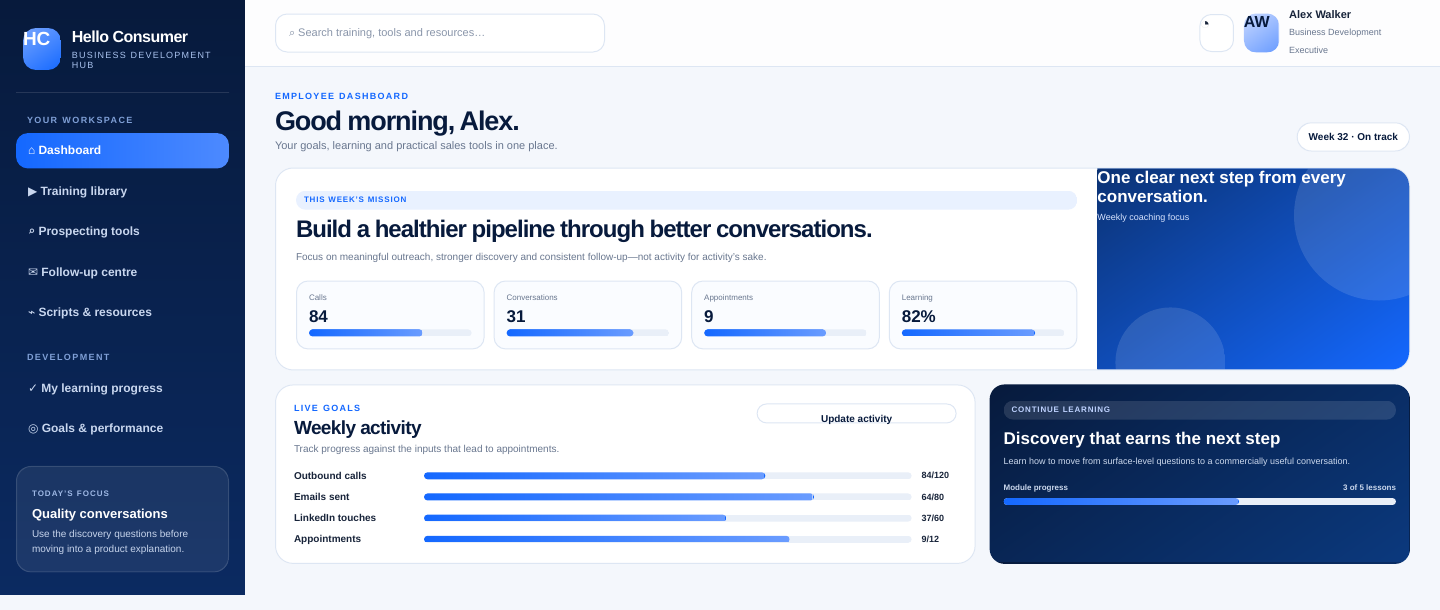
The employee dashboard is being designed as a personal performance area—not just a company noticeboard. Each individual can see their own learning progress, goals, activity and development priorities, helping them take greater ownership of improvement.
Work backwards from an appointment, revenue or earnings goal to a practical daily and weekly activity plan.
Employees can compare their current progress with the pace required instead of waiting until the end of the month to discover a gap.
Recommended lessons and manager-agreed goals give each person a specific skill or behaviour to improve—not a vague instruction to “do more”.
Completed learning, milestones and improving activity create a stronger sense of momentum and accountability.
Each employee would have their own secure view of goals, learning and development.
Prototype preview: reporting measures can be shaped around the final company setup and available data.
The Manager Hub is being designed to connect training progress with the individual picture. Instead of relying only on a final sales number, managers can review the behaviours and development areas that may be affecting performance.
Review team learning, activity, conversation and appointment indicators from one starting point.
Open a personal snapshot showing goals, progress, strengths, gaps, agreed priorities and recent development.
See which modules are complete, which are overdue and where a refresher or new training pathway may be useful.
Prepare team reports, individual snapshots, training reports and leadership summaries without rebuilding the information manually.
Switch between the current prototype views. Each screen is designed around the work salespeople and managers need to complete—not around a passive library of generic content.
Each employee can see their own goals, required pace, learning progress, recent activity and the next development priority agreed with their manager.
The value is not simply having more content. It is creating a repeatable way to train people, translate targets into action, identify gaps and keep development moving.
Give every new starter the same core pathway, examples and expectations while managers focus on practice and feedback.
Keep learning available throughout the employee journey instead of treating development as a one-off event.
Help employees understand the activity and behaviours behind their own target rather than depending on constant reminders.
Spot falling pace, incomplete learning or a conversion gap before it becomes a full missed month.
Use the individual record to discuss a specific goal, skill or pattern instead of relying on broad performance conversations.
Share clearer summaries of team progress, development and support needs without rebuilding reports from multiple systems.
The planned white-label edition will combine the core platform with your company identity, customer journey and commercial priorities. Training can reflect your products, services, target customers, real objections, scripts and standards—so employees learn the way your business wants them to sell.
The planned service combines platform setup, sales-training expertise and practical consultancy. The aim is to create a useful company environment—not hand over an empty system and leave you to build everything yourself.
Review roles, targets, customer journey, current training, tools and the points where performance or consistency is being lost.
Apply branding, create the learning pathway and add the right videos, goals, tools, scripts, resources and manager views.
Give employees and managers a practical introduction to the platform, personal goals and the ongoing development process.
Review learning, goals, coaching priorities and feedback so the Hub develops alongside the team and the business.
Tell us where your current process breaks down—onboarding, inconsistent sales conversations, unclear activity goals, scattered resources or limited manager visibility. We will show you the current prototype and discuss how a company edition could be shaped around that problem.
The product is coming soon. These answers explain the intended direction without presenting unfinished features as fully launched.
It is a sales training and performance platform being developed to combine practical training videos, prospecting and follow-up tools, personal goals, individual progress tracking and manager reporting in one branded company hub.
The planned library will include short practical modules that can support onboarding, pre-call preparation, refresher training and manager-led development. Employees will be able to revisit relevant lessons rather than relying on notes from a one-off workshop.
Yes, that is central to the planned employee experience. Each person would have their own dashboard showing goals, required activity, learning progress, milestones and agreed development priorities so they can see what to work towards.
The current design includes a team overview, individual employee records, learning progress, performance goals, activity and conversion indicators, development snapshots and shareable team, training and leadership reports.
The planned individual record is intended to support employee-specific goals and coaching priorities. This means one person can focus on prospecting activity while another works on discovery, objection handling, follow-up or conversion.
The planned white-label company edition is designed to support client branding, training videos, scripts, templates, product or service knowledge, sales processes and manager expectations.
It is aimed at companies with business development, appointment-setting, outbound sales, field-sales or account-development teams—particularly organisations that want more consistent onboarding, clearer individual accountability and better manager visibility.
No. The Hub is coming soon and is not yet being presented as a finished public product. Early-access enquiries and private prototype discussions are open while the platform is developed and tested.
A fixed public launch date and final pricing have not been announced. Pricing is expected to depend on team size, company branding, content requirements, goals, manager features and ongoing support.